
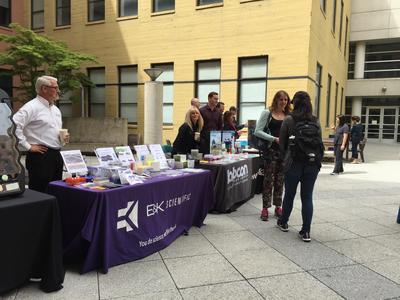
Once a semester, Cal Zero Waste hosts a roadshow event to showcase and promote environmentally preferred alternatives for office and lab supplies.
Our next EPP Roadshow will be in early April 2020! More details will be available soon.
Purchasing Information
- For purchasing information, such as SKU, price, and quantity per package, refer to these handouts for our featured products:
- Archived Product Lists
- All products are available on campus purchasing platform BearBuy.
 .
.

At the roadshow, products that produce less waste than their counterparts or are made out of recycled content are showcased. All products being displayed have been carefully vetted to ensure that they align with zero waste product standards. For example, Pilot’s B2P (Bottle to Pen) is a pen made out of recycled plastic water bottles, which means it is a #1 PET plastic and is readily recyclable. It is also refillable which allows for the continual use of the pen while only throwing away the empty ink cartridge.
During the event, samples of the products are distributed and building occupants are educated on waste reduction and why the selected products are environmentally preferred. Thus far, EPP Road Shows have been held at the Campus Shared Services Center, California Hall, Wurster Hall, the Haas School of Business, the Valley and Life Sciences Building (VLSB), Li Ka Shing, and Stanley Hall.
Fall 2018 Roadshow
Publicity
- Daily Cal Article: Cal Zero Waste holds Environmentally Preferred Products Road Show on campus
Interested in tabling at the next Roadshow? Check out the product guidelines.
zero waste product guidelines
DESIGN +MATERIALS:
- Material is designed to deconstruct. The whole product should not have to be replaced. For example, Pipette tip boxes. The preferred design would be for the wafers to be replaced rather than the whole box be replaced.
- If the product has recyclable parts, those parts should be recycled into one of the company's other products, if not the same product that the part came from.
- Paper products should be designed to be compostable.
- If plastics are being used, they should only be plastics #1 and #2. Only #1 and #2 are recyclable in Berkeley.
- If a product cannot be reused, repaired, disassembled, remanufactured, recycled or composted it should be redesigned or progressively phased out from the market.
- If the product does have compostable or recyclable parts, ensure that the information is accessible, clear, and detailed.
PACKAGING
- If the product includes styrofoam in the packaging, it is not zero waste. Styrofoam must be landfilled.
- Packaging must be separable so that the pieces can be disposed of properly. If there is aluminum stuck to cardboard, that is not separable and does not constitute as zero waste. Aluminum is bottles & cans recycling, while cardboard is mixed paper.
- Once the product has been used, every part of the packaging should be either compostable or recyclable. The product should not be shipped in styrofoam containers.
- The company should offer take-back programs to reduce waste on campus. The company should not use an enormous amount of packaging to deliver the product.
- An example of zero waste packaging is how Amazon Fresh delivers items in reusable totes that they pick up on your next order.
TRANSPORTATION:
- If the products themselves are recyclable, the company should be offering take-back programs that recycle those products at a local facility.
- The product should be repaired, disassembled, remanufactured, recycled or composted at a local facility.
- For example, VWR is recognized by the EPA as a SmartWay Transport partner. See here
Zero Waste
- Volume must be maximized. >>> look to reduce volume (reducing volume = reducing waste).
The Model to Use
